War crimes
Baralong incidents
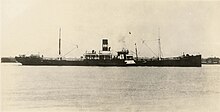
On 19 August 1915, the German submarine U-27 was sunk by the British Q-ship HMS Baralong. All German survivors were summarily executed by Baralong's crew on the orders of Lieutenant Godfrey Herbert, the captain of the ship. The shooting was reported to the media by American citizens who were on board the Nicosia, a British freighter loaded with war supplies, which was stopped by U-27 just minutes before the incident.
On 24 September, Baralong destroyed U-41, which was in the process of sinking the cargo ship Urbino. According to Karl Goetz, the submarine's commander, Baralong continued to fly the US flag after firing on U-41 and then rammed the lifeboat—carrying the German survivors, sinking it.
Torpedoing of HMHS Llandovery Castle
The Canadian hospital ship HMHS Llandovery Castle was torpedoed by the German submarine SM U-86 on 27 June 1918 in violation of international law. Only 24 of the 258 medical personnel, patients, and crew survived. Survivors reported that the U-boat surfaced and ran down the lifeboats, machine-gunning survivors in the water. The U-boat captain, Helmut Patzig, was charged with war crimes in Germany following the war, but escaped prosecution by going to the Free City of Danzig, beyond the jurisdiction of German courts.
Blockade of Germany
After the war, the German government claimed that approximately 763,000 German civilians died from starvation and disease during the war because of the Allied blockade. An academic study done in 1928 put the death toll at 424,000. Germany protested that the Allies had used starvation as a weapon of war. Sally Marks argued that the German accounts of a hunger blockade are a "myth," as Germany did not face the starvation level of Belgium and the regions of Poland and northern France that it occupied. According to the British judge and legal philosopher Patrick Devlin, "The War Orders given by the Admiralty on 26 August were clear enough. All food consigned to Germany through neutral ports was to be captured and all food consigned to Rotterdam was to be presumed consigned to Germany." According to Devlin, this was a serious breach of International Law, equivalent to German minelaying.
Chemical weapons in warfare
The German army was the first to successfully deploy chemical weapons during the Second Battle of Ypres (22 April – 25 May 1915), after German scientists working under the direction of Fritz Haber at the Kaiser Wilhelm Institute developed a method to weaponize chlorine.j The use of chemical weapons was sanctioned by the German High Command in an effort to force Allied soldiers out of their entrenched positions, complementing rather than supplanting more lethal conventional weapons. In time, chemical weapons were deployed by all major belligerents throughout the war, inflicting approximately 1.3 million casualties, but relatively few fatalities: About 90,000 in total. For example, there were an estimated 186,000 British chemical weapons casualties during the war (80% of which were the result of exposure to the vesicant sulfur mustard, introduced to the battlefield by the Germans in July 1917, which burns the skin at any point of contact and inflicts more severe lung damage than chlorine or phosgene), and up to one-third of American casualties were caused by them. The Russian Army reportedly suffered roughly 500,000 chemical weapon casualties in World War I. The use of chemical weapons in warfare was in direct violation of the 1899 Hague Declaration Concerning Asphyxiating Gases and the 1907 Hague Convention on Land Warfare, which prohibited their use.
The effect of poison gas was not limited to combatants. Civilians were at risk from the gases as winds blew the poison gases through their towns, and they rarely received warnings or alerts of potential danger. In addition to absent warning systems, civilians often did not have access to effective gas masks. An estimated 100,000–260,000 civilian casualties were caused by chemical weapons during the conflict and tens of thousands more (along with military personnel) died from scarring of the lungs, skin damage, and cerebral damage in the years after the conflict ended. Many commanders on both sides knew such weapons would cause major harm to civilians but nonetheless continued to use them. British Field Marshal Sir Douglas Haig wrote in his diary, "My officers and I were aware that such weapons would cause harm to women and children living in nearby towns, as strong winds were common in the battlefront. However, because the weapon was to be directed against the enemy, none of us were overly concerned at all."
The war damaged chemistry's prestige in European societies, in particular the German variety.
Genocide and ethnic cleansing
Ottoman Empire
The ethnic cleansing of the Ottoman Empire's Armenian population, including mass deportations and executions, during the final years of the Ottoman Empire is considered genocide. The Ottomans carried out organised and systematic massacres of the Armenian population at the beginning of the war and portrayed deliberately provoked acts of Armenian resistance as rebellions to justify further extermination. In early 1915, a number of Armenians volunteered to join the Russian forces and the Ottoman government used this as a pretext to issue the Tehcir Law (Law on Deportation), which authorised the deportation of Armenians from the Empire's eastern provinces to Syria between 1915 and 1918. The Armenians were intentionally marched to death and a number were attacked by Ottoman brigands. While an exact number of deaths is unknown, the International Association of Genocide Scholars estimates 1.5 million. The government of Turkey has consistently denied the genocide, arguing that those who died were victims of inter-ethnic fighting, famine, or disease during World War I; these claims are rejected by most historians.
Other ethnic groups were similarly attacked by the Ottoman Empire during this period, including Assyrians and Greeks, and some scholars consider those events to be part of the same policy of extermination. At least 250,000 Assyrian Christians, about half of the population, and 350,000–750,000 Anatolian and Pontic Greeks were killed between 1915 and 1922.
Russian Empire
Many pogroms accompanied the Russian Revolution of 1917 and the ensuing Russian Civil War. 60,000–200,000 civilian Jews were killed in the atrocities throughout the former Russian Empire (mostly within the Pale of Settlement in present-day Ukraine). There were an estimated 7–12 million casualties during the Russian Civil War, mostly civilians.
Rape of Belgium
The German invaders treated any resistance—such as sabotaging rail lines—as illegal and immoral, and shot the offenders and burned buildings in retaliation. In addition, they tended to suspect that most civilians were potential francs-tireurs (guerrillas) and, accordingly, took and sometimes killed hostages from among the civilian population. The German army executed over 6,500 French and Belgian civilians between August and November 1914, usually in near-random large-scale shootings of civilians ordered by junior German officers. The German Army destroyed 15,000–20,000 buildings—most famously the university library at Louvain—and generated a wave of refugees of over a million people. Over half the German regiments in Belgium were involved in major incidents. Thousands of workers were shipped to Germany to work in factories. British propaganda dramatising the Rape of Belgium attracted much attention in the United States, while Berlin said it was both lawful and necessary because of the threat of franc-tireurs like those in France in 1870. The British and French magnified the reports and disseminated them at home and in the United States, where they played a major role in dissolving support for Germany.


Comments
Post a Comment